Less than two weeks out from the first Democratic primary in Iowa, the field still consists of a dozen Presidential hopefuls. The candidates run the entire spectrum from anti-establishment, anti-billionaire Bernie Sanders, to pro-establishment, actual-billionaire Michael Bloomberg.
Despite how much time social media, privacy, data, election fraud and tech-competition issues have filled the airways over the last 18+ months, tech hasn’t really been a major feature of the Democratic primaries — certainly not as much as say healthcare, immigration or education.
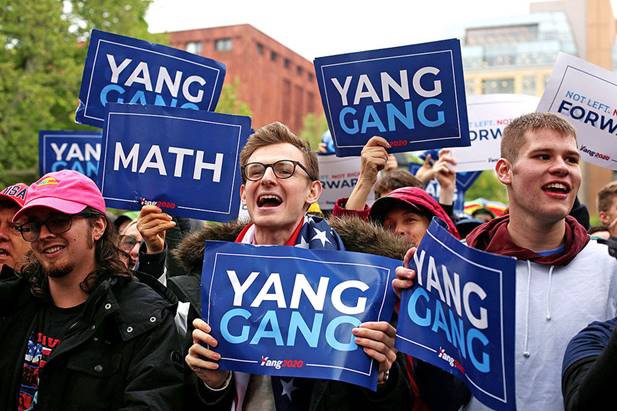
Serial entrepreneur Andrew Yang is the one exception. Yang — who’s running under the slogan Make Americans Think Harder — has built a campaign about the 4th Industrial Revolution, the threat posed by automation and the promise of a universal basic income he’s calling the Freedom Dividend.
“Working in retail is the most common job in America, and call centers currently employ 3.3 million Americans. However, over the next four years, experts project that about 30 percent of malls are at high risk of closing and software that can replace call center workers is already coming online, displacing these workers. The same will happen to the millions of truck drivers on our roads and food prep workers in our restaurants.”
(It’s a strategy that’s earned him 3.5 per cent support and the endorsements of Terri Hatcher, Michael Rappaport andNicholas Cage).
When candidates have spoken about their tech policies, they’ve tended not to be all too friendly. Senators Warren and Sanders for example, have been openly hostile towards Silicon Valley, and have gone so far as to refuse donations from the sector. Vice President Biden and Mayor Buttigieg have been more embracing, but even they have called for greater scrutiny.
The nomination is still anyone’s game. Some have suggested that we could be headed for a brokered convention (cf West Wing s06e21, VEEP s07e07 and House of Cards s04e09). And with no clear winner in sight, it’s worth understanding the broad differences in the frontrunners’ (and Yang’s) positions on tech should they become the next POTUS.
· Biden — has been notably quiet on tech issues, with the exception of criticising how social media platforms have handled false or misleading political ads.
· Bloomberg — “Breaking things up just to be nasty is not an answer… You’ve got to have a good reason and how it would work, and I don’t hear that from anybody.”
· Buttigieg — “we need to hold our online platforms accountable, demand comprehensive privacy protections, set standards of accountability and transparency for online political ads, elevate ongoing antitrust enforcement reviews, and ensure we keep market power in check for the benefit of consumers.”
· Klobuchar — Has pledged to add muscle to antitrust and consumer protection agencies citing the creation of “a more stringent legal standard” for approving mergers by “shifting the burden of proof” to companies to show that a merger won’t reduce competition. Klobuchar has also promised to establish the “digital rules of the road” for privacy, calling for stronger enforcement authority for agencies.
· Sanders — “…the most important tech-related issue of today is the enormous concentration of economic and political power in the hands of a few massive, unaccountable technology firms. Google, Facebook, Amazon… have too much power and should be broken up… we must regulate tech companies to serve the public interest, not just their bottom lines, and rid our democracy of corporate money once and for all. When [I am] president, we will restore net neutrality, guarantee strong data privacy protections, end the Orwellian mass surveillance of our people, guarantee affordable high-speed internet to all, and ensure technology benefits society, not just the 1 percent.”
· Warren — “[Amazon] runs the platform, gets all the information, and then goes into competition with those little businesses. Look, you get to be the umpire in the baseball game or you get to have a team, but you don’t get to do both at the same time. We need to enforce our antitrust laws, break up these giant companies that are dominating Big Tech, Big Pharma, Big Oil, all of them.”
· Yang — “Technology is quickly displacing a large number of workers, and the pace will only increase as automation and other forms of artificial intelligence become more advanced… This has the potential to destabilize our economy and society if unaddressed.”
More on the candidates’ attitudes towards tech can be found here, here and here.
Interestingly, while tech may not be top of mind for most of the candidates, it’s certainly playing a role in how the campaigns are being run and who might eventually win the nomination.
Post script: At the risk of having my name attached to a list of once-relevant celebrities, no endorsement should be implied from this note.
 TALES FROM THE LONG TAIL
Leave a comment