
This note is an abbreviated talk I gave at the Department of Energy’s Rare Earths Supply Chain Workshop in Golden, Colorado.
For a long time, most of the presentations I did on the resources sector started with a chart that looks like this [chart of mining investment exploding up and then coming off the boil]. And we’d talk about the once in a 100 year mining boom. How we’ve moved out of the investment phase and into the production phase.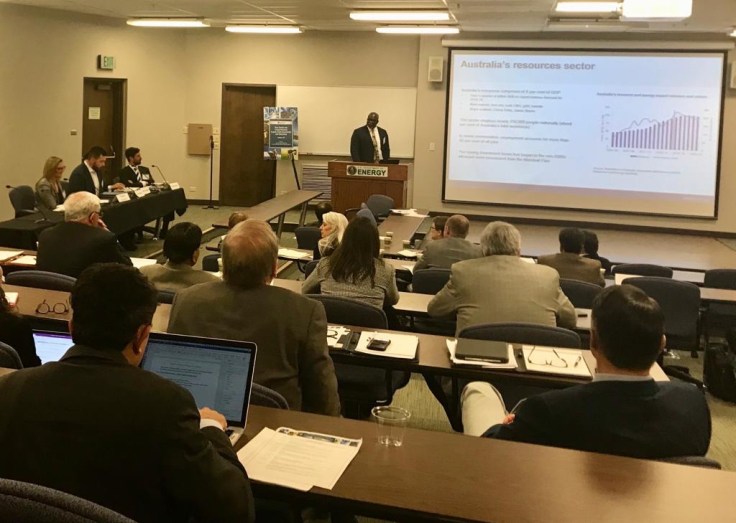
There was always a question at the end of this presentation though about “what comes next?”, “what’s required for an 21st Century mining industry?”.
The answer to that question came via the National Resources Statement in February. This was the first policy document of its kind in 20 years. At a very high level, the Statement talks about the need to keep Australia as an attractive investment destination for resources projects, opening up new projects, investing in mining technology, job creation and skill development, and working with regional communities to ensure that the immense benefits of these projects are shared by all.
Many of the elements listed on the US’ critical minerals list will feature as part of Australia’s vision for a 21st century mining sector. Australia has economically demonstrated resources for 19 of the US’ 35.
Recognizing developments in the space we released the Australian Critical Minerals Strategy was released in April. The Strategy provides a framework to promote upstream and downstream investment, incentivize innovation in the sector and plug critical minerals projects into infrastructure development.
Complementing this document was a prospectus produced by our Trade and Investment Commission, that details the specific, shovel ready projects in this space.
I think there’s a reason why Australia has been invited to this forum. We’re obviously endowed with vast quantities of resources. But I want to stress, what might be less well known, the upstream capabilities held by Geoscience Australia regarding precompetitive geological survey information, the innovations that come from our METS sector, and industry’s ability to set goal posts when it comes to extraction technologies and environmental impacts.
Now with all that in place, it’s still not enough. Despite all the momentum thats happened in the US since the ExOrder in December 2017 [EO13817], talk to Australian industry and they’ll tell you problems about access to finance. There are problems securing off take agreements. The big consumers of critical minerals operate in competitive, cost-conscious markets. The supply chains are opaque, vertically integrated, manipulated.
This list of critical minerals underpin a profound technological revolution, and will be the building blocks of the 4th Industrial Revolution. Yet for many of these minerals, you’d have to describe their markets as immature, at best underdeveloped.
Historically, we have tended to think of resources issues as an economic or strategic issue. Precisely which, usually depends on the end use of the commodity.
What makes critical minerals different is that their end uses are technologies that are being applied universally to a spectrum of both strategic and economic uses. Therefore we need to think about this much more holistically.
The Australian Embassy in DC is enormous, about 350 people. It’s a mini-Australian Government that houses the foreign service of course, but also Defence, treasury, Resources, trade etc. Whenever there’s a development in the US, a meeting is called that convenes all of the agencies with equities in this space. About 350 people turn up.
In July this year, the Australian Government established a whole of Government Critical Minerals Taskforce that more or less mirrors the dynamic here. The taskforce is being run by the Prime Minister’s department (and being watched closely by the PM himself). It was tasked with developing a framework to assess and manage the risks associated with the CM supply chain, and consider the market failures that prevent a domestic industry from further developing.
Its been interesting hearing the discussions thus far. As a supplier of CMs our agenda is the ying to your yang. (The Stephen Strasburg to your Yan Gomes?) Where the US is looking for strategic suppliers of CMs, we are looking for strategic buyers.
For good reasons, we’re hesitant to go out on a mine development limb without knowing we’ll have the security of strategic buyers and partners once they’re up and running.
I’ll finish by saying that we are hearing very positive messages come out of the US. Our Prime Minister visited last month and discussed cooperation opportunities with the President. We know that the two of them poured over maps of the US and Australia and discussed key projects lithium, cobalt, rare earth and uranium projects across the two countries.
Tommy said all the right things just now. “We need to work with our international partners.” And my response to that is meant to be provocative: who is the “we” that he is talking about? Australia and America are both market economies. Our industry and yours have been doing business for decades. Working together is then norm, I don’t think that’s the problem. Solving this challenge will require a more strategic response.
Later this month, we plan to have both the Minister for Resources and Northern Australia in DC meeting with US counterparts to develop an action plan and a series tangible steps to advance this program together.
 TALES FROM THE LONG TAIL