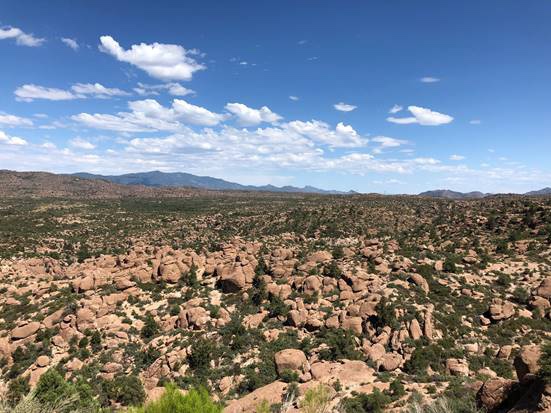
A gorgeous hour drive from the centre of Phoenix sits the somewhat in-audacious town of Superior, Arizona. Surrounded by rolling desert hills and cacti, Superior makes you forget that you’ve just left the fifth largest city in America. It could just as well be (it was) the backdrop of Bonanza.
Home to just 3000 residents, the town offers the chance to be “the place over the rainbow, where every person can be afforded the opportunity to succeed.”
It helps that at the end of the rainbow is the largest copper ore deposit in North America, and an $8 billion joint venture between Rio Tinto and BHP, Resolution Copper.
Resolution was bought from the Magma Copper Company in 1996, which had been operating since 1910. It was shut down shortly after, however exploration continued.
28 million tons of ore was extracted by Magma over its 86 years in operation. (All going well,) Resolution will extract about 100,000 tones a day when at full capacity. The JV has already invested $2 billion, expanding capacity – including deepening the existing shaft, and building another – safety upgrades, air conditioning (temperatures at the bottom of the shaft reach 82 degrees Celsius), and extensive geological surveys.
The plan is to next dig a 4km tunnel from the bottom of the shafts (2km underground) to the edge of the of the deposit. And if that’s successful, they’ll start block cave mining 2 billion tones of ore.
When at peak production, the mine will meet about 25 per cent of the US’ annual copper demand. The project promises 1400 direct jobs (for people, not robots) and another 2300 indirect (including an unspecified number of firefighters, teachers and nurses #comms). Over $20 billion is promised in federal, state and local tax revenues over the life of the project. This is the largest project in the US’ permitting process.
The operation will make use of all sorts of science and tech. There are enough sensors underground to warrant the installation of an entire server room at the bottom of the mine. The tunnels will soon be fitted out with high speed WiFi. The operation boasts an unusually large geology department. Around 40 geologists and support crew are stationed in a Superior warehouse facility analysing endless rows of core samples.
Everything about this venture screams “mine of the future”. The one exception is the signalling system used to operate the elevator. Arizona regulations require miners to use a Morse code-like system to communicate with an elevator operator. That said, EVERYTHING about this mine is safety-first, and the regulations are designed to be fail proof. But there’s something about the way the miner has to dot dot and dash dash that is at odds with the data centric, tech embracing, WiFied operation. One suspects that this is just one of a number of seemingly archaic regulations the mine has must comply with.
The mine will have an impact on the environment and on areas of significance to indigenous communities. The mine will progressively lower the the surface above, eventually creating a crater 3kms wide and 300 meters deep. The total surface disturbance will be just short of 30 square kms. Plus there are the tailings which have to be dealt with. Key to the approvals process has a been a land swap between the Resolution and the Federal Government, that saw an equisized parcel of land forfeited by Resolution to become a national park.
Its 2019, and projects like this can’t get up without a social license. Resolution has committed to supporting local capabilities. They’ve provided the local schools (school?) with new computer equipment. They find a number of scholarships at the surrounding universities. They run an apprenticeship program and have committed to local employment. There’s funding for a new municipal building and a significant upgrade of paramedic and emergence response facilities. And so on and so on.
Resolution’s approach has been one of significant engagement with the community. A community engagement office has been set up on the main street (around the corner from the newly refurbished hotel and in between recently popped up cafes and galleries) to answer any questions. Its full of 3D maps with substitutable panels to show before and after effects of different alternatives. Its also where the community advisory committee meets with Resolution on a regular basis.
Superior is in the heart of the Arizona copper triangle. You get the feeling that if you meet a Superian that wasn’t directly employed by the mine, their father or grandfather would have been. Its unsurprising that the project has a lot of local support(there is of course opposition). But to be fair to the largest project in the US permitting process, which happens to be JV between to Australian companies, the pitch is right on: Resolution Copper is an example of a science led, environment and community minded, high tech, safety conscious modern day resources project.
 TALES FROM THE LONG TAIL
Leave a comment