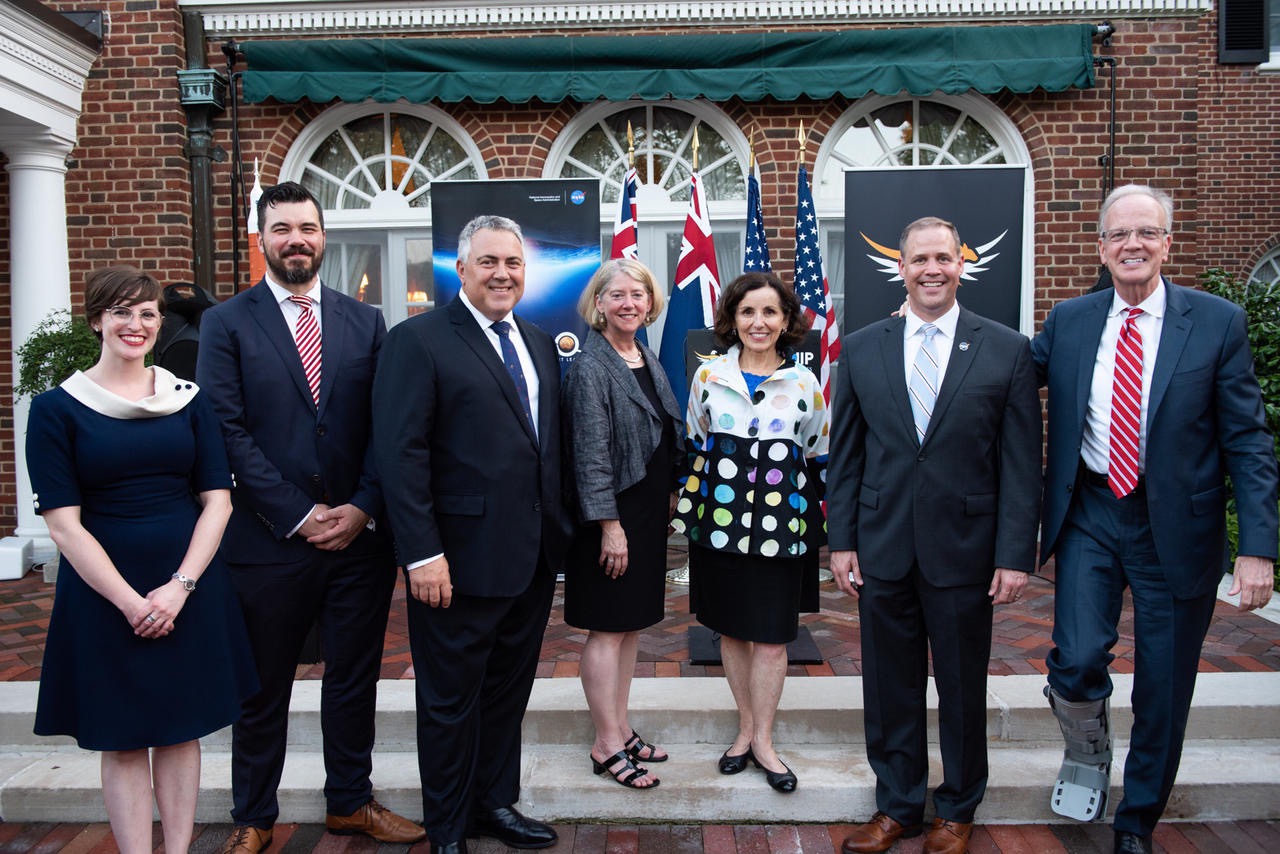
This week’s edition features an abbreviated version of a talk I gave at a reception celebrating the 50thAnniversary of the Apollo 11 moon landings, and Australia’s involvement in beaming those images around the world. Our special guests included NASA Administrator Jim Bridenstine, NSF Director France Cordova, former
I went looking for a story that would capture the essence of the Australia and space. There is of course the amazing story about the Dish, which beamed images of the moon landing around the world in 1969. But I’ll leave that for the Ambassador and the NASA Administrator to reflect upon.
I could talk about amazing earth observations capabilities, and how we’ve built a data cube that’s taken a photo of every 25 square meter block of the country, every two weeks for the last 31 years. And how that’s being used to assist with bush fire and flood management.
Or maybe even about the autonomous technologies Australian companies are using to remotely operate mines in the outback from 1000 miles away. And how we’re looking to apply those capabilities to support space missions.
But no, my quintessentially Aussie space technology story is about a little known start-up called Vostok.
About a year ago, big plans were announced to build a luxury space hotel some 200 miles above the earth’s surface. 12 night all-inclusive packages at the Aurora Station are available in 2021 for just $9.5 million. They come with a promise of spectacular views, zero gravity and complementary wifi.
That sounds amazing. What would be more relaxing then circumnavigating the earth every 90 minutes, and kicking back to watch the 16 sunsets a day with a nice, ice cold beer?
It almost sounds too good to be true.
And it kind of is. You see, space poses a number of serious challenges for beer.
- First, the lack of gravity means that the gasses in the beer don’t rise. There’s no foam, and there’s no carbonation. The result is a muted sensation on the tongue and a very dull flavour. Worse, in the stomach the bubbles all clump together and they create what’s known as a rather uncomfortable “wet burp”.
- Second, we have no idea how alcohol affects the body in space. Human physiology changes in microgravity, and presumably so too does the impact of alcohol.
- And third, even if you could get the taste right, and understood the impacts on the body, how would you even serve the beer? Previous efforts of carbonated drinks have involve either squeezing the liquid from a bag or slurping it up through a straw. I understand that in the early days, the Russians dabbled with freeze dried beer.
Hmmm. Could you imagine a Space-Pub with No Beer? The reviews on TripAdvisor would be awful: “wonderful service, no atmosphere”.
Enter the Australians. Vostok, or as they’re also known, the Vostok Space Beer Company, made it their mission to solve this problem.
- First they worked with a Sydney brewery, to create a low-carbon, high-flavour Irish-styled stout. Something that would take the bubbles out of the beer, while retaining the flavour.
- They then spent over $250k engineering a 3D printed space bottle that used a sophisticated wicking mechanism to draw the beer out of the bottle and simulate a realistic drinking experience.
- And then they tested — in microgravity — the impact it had on the human body, all the while paying attention to the customer experience.
Now, as tremendous as this story is, I want to stress that it’s the undertones of innovation, entrepreneurship, collaboration, commercialisation and inspiration that make it so great. In order to solve a problem as seemingly simple as space beer, Vostok had to forge together a consortium of Australia’s space, health sciences, food and agribusiness, advanced materials, industrial design and manufacturing sectors — and take a risk.
And while it may sound trivial, I think space-beer is also a highly symbolic, milestone. If we’re cracking open space beers, it means that one, we feel safe enough and comfortable enough to put our feet up, and two, that we’re probably going to stay a while.
Now before we start with all the “One small stout for man, one giant larger for mankind” talk, we have to remember that we are now in Space 2.0. The commercial sector will play an enormous role in our next space adventures. And ventures like this need to be economic. As great a product as I’m sure it was, Vostok fell well short of their funding ambitions. Space beer, I’m sad to say, remains a problem yet to be solved.
The Australian Space Agency was launched just over a year ago — not to specifically solve this problem — but to help solve the broader problems of innovation and collaboration across the Australian civil space sector.
The Australian Government has set an ambitious task of tripling the size of the sector to $12 billion, 30 thousand jobs and a $1 billion pipeline of investment.
To date the Government has invested $300 million in Australia’s space capabilities. And we’ve recently signed MOUs with France, Canada, the UAE, UK, Lockheed Martin and Boeing. We are, of course, working in hand in hand with our mates in the US. Late last year we held the inaugural US/Australia Civil Space Dialogue, and we look forward to the next one soon.
The Australian Space Agency looks to NASA with much reverence. There is no government agency, let alone space agency that enjoys more global brand recognition than NASA. Australia has enjoyed a long and successful relationship with NASA for over 50 years. Today we celebrate their superhuman feet, and Australia’s contribution to putting the first ever boots on the Moon.
We also mark this anniversary by asking, what’s next? In this new era of space exploration it’s clear no country can go it alone. NASA and Australia and so many other nations will need to join forces in order to explore the furthest reaches of space.
 TALES FROM THE LONG TAIL
Leave a comment