
The US higher education system comprises of nearly 4,000 colleges and universities, 20 million students and 1.6 million faculty. Public and private providers offering an array of two and four year degrees. There are twice as many universities in the state of Louisiana as there are in Australia.
The peak body that represents this sector is the American Council on Education (ACE). ACE is the only major higher education association to represent all types of US accredited, degree-granting institutions. This week ACE President Ted Mitchell, outlined the state of the sector as the good, the bad, and the ugly to an invite only crowd from Embassy Row.
First the good. Access to higher education continues to expand, particularly for minorities, low income and rural households. About 70 per cent of high school completers enrol in post-secondary education. This is up from 63 per cent at the turn of the century.
American universities, writ large, continue to be a destination of choice for international students and researchers alike. This, Mitchell stresses, is critical. American students “need to be connected to a global society”. The diversity that international students bring to the table contributes to a “connected and inclusive” society.
The sector is overlayed with strong bilateral and multilateral agreements between countries and institutions. As the domestic and global political environment becomes less stable, these relationships are only going to become more important.
The bad. There is no doubt, Mitchell believes, the actions (particularly around visas) and rhetoric of the current Administration are having a chilling effect on prospective international students and researchers. Anecdotes are amassing across the sector, and are beginning to translate into data.
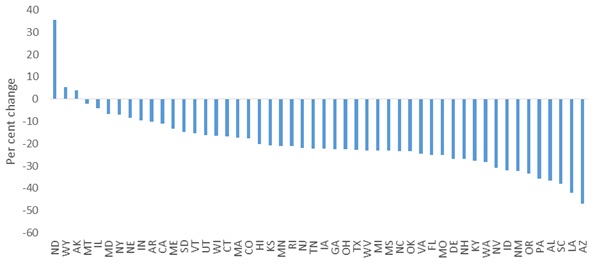
State Government support for universities hasn’t picked up since the GFC. Last year was also the first time ever that public colleges and universities in most states received most of their revenue from tuition rather than government appropriations.
Per cent change in state spending per student at public universities, 2008-2015
Source: Center on Budget and Policy Priorities
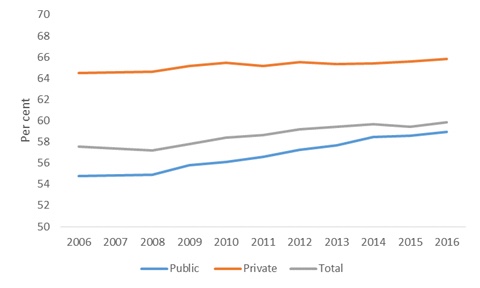
While access is increasing, only 3 in every 5 students actually complete their degree — even fewer complete two year programs. Private universities with more selective entry requirements tend to do better (65.9 per cent completion) than public institutions (58.9 per cent). This is particularly concerning when coupled with issues about rising student, which students of course assume even if they don’t complete). For context, rates are slightly higher in Australia.
University completion rates, four year programs completed within six years of commencement, 1996-2010
Source: NCES
The types of students that fail to complete their program aren’t randomly distributed. More likely than not, they’re the first generation students, minorities and rural students that form much of the “good” narrative. Mitchell describes falling completion rates as “the biggest problem facing US higher education”.
And finally, the ugly. ACE are dismayed by the extent and pace at which student protections are being wound back. The most hotly contested is the proposal to scrap the “gainful employment” regulations that were introduced under the previous administration. These regulations imposed sanctions on career-training programs that consistently produced graduates whose income was too low relative to their student debt.
This is just part of the Administration’s broader agenda to “deregulate the industry, reduce or eliminate federal subsidies, promote private-sector competition, and make higher education more responsive to the needs of business.”
Perhaps the most concerning issue is the “measureable decline in the community’s confidence in the sector”. The overarching finding of a recent Pew Research Centre study for example, found that 61 per cent of Americans thought the higher education system was going in the wrong direction. Predictably, Republicans and Democrats disagreed on why — Republicans citing students not getting the skills they need to succeed in the workplace, and Democrats more likely to cite high tuition costs. Either way, Mitchell said, there appears to be a shared belief that colleges and universities “do not have the community’s best interests at heart”.
 TALES FROM THE LONG TAIL
Leave a comment