
Clamato: a briny blend of tomato juice and clam broth, that when mixed with vodka becomes “one of Canada’s top selling” cocktails. Clamato forms the foundation of a uniquely Canadian take on the Bloody Mary, the Caesar. The popularity of Caesars on Ottawa’s brunch menus is one of the few observable differences between Down Under and Up Over. The two countries share remarkably similar histories and institutions, and are now contending with the same policy problems.
On most fronts, policy processes in Australia and Canada seem to sit within a 6-18 month window of one another. The differences in our approaches are subtle enough to offer powerful and insightful Sliding Doors of what could have been.
Take digital for example. On most available metrics, Australia and Canada sit side by side. The WEF’s 2016 Network Readiness Index for example (but also see WEF, EIU, Katz and Koutroumpis and just released HBR) scores Australia an 86 (distance from the frontier, see postscript), and Canada an 88. Even on the sub-indices we’re basically inseparable.
WEF Network Readiness Index, distance to the frontier, Australia and Canada
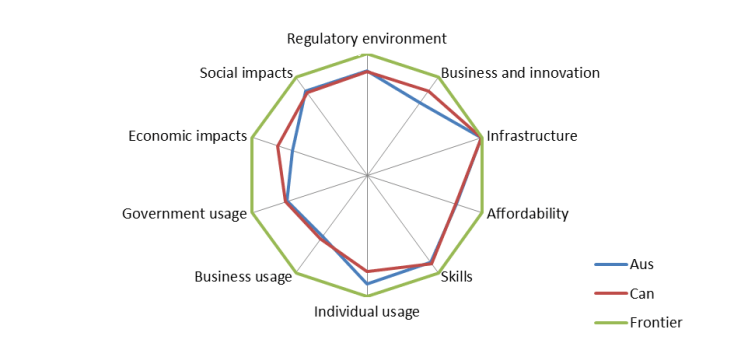
Notes: I’m reluctant to put ascribe too much weight to rankings provided by the WEF (Aus 18, Canada 14) or others (the EIU: Australia first and Canada 15th; Katz and Koutroumpis: Australia 16th and Canada 9th). These rankings have enough issues in the way they are constructed, and a minor change can see a country either rocket or plummet. In contrast, DTF measures the relative gap between an economy’s performance and best practice. A score of 86, suggests that Australia is 14 percentage points away (whatever that means) from the top performing country.
Source: WEF and me.
And Canada, like Australia, is grappling with how to best prepare the economy for future digital technologies. In essence: how do we balance efforts to increase data access and availability in order to foster innovation, against efforts to safeguard data in the name of privacy and security?
The Canadian Government has just launched an eerily familiar consultation process. The National Digital and Data Consultations will support the development of a new Digital and Data Strategy that will be released later this year.
But the answer to this question is probably different to what it would have been nine months ago.
The announcement of the Strategy’s has broadly welcomed, but it’s unfortunately come at a time when the prevailing zeitgeist has been set by the Cambridge Analytica scandal. Issues about trust and security are likely to dictate the nature of the consultations. For instance:
“[The announcement is] welcome news among the thousands of privacy professionals in Canada who have been calling for this for several years now” (K. Klein, International Association of Privacy Professionals, Canada)
“[T]he federal government recognizes that a strategy is required to balance privacy, consumer trust and the security needs of Canadians” (R. Watson, Information Technology Association of Canada)
Timing is everything. Australia’s Digital Economy Strategy Consultation Paper — which was released pre-Cambridge — emphasised competitiveness and inclusion. Indeed, the words “privacy” and “cyber security” didn’t appear in the glossy until pages 14 and 20. And even then, their first use was in relation to building industries around the development of cyber security technologies. The PC’s inquiry into Data Availability and Use, which was also drafted ahead of the scandal, spoke of building trust over building fences.
It will be interesting to see how these consultations develop and how far the pendulum will swing. Think tanks like the Institute for Competitiveness & Prosperity are cautioning against a “race to the bottom” from excessive data localisation policies. But they’ll need to be heard over others are dropping phrases like “surveillance capitalism” and “data cows”.
It’s important to get the strategy right. Tomorrow’s technologies are here now (watch this video of a robot doing a backflip). How fast a country adopts those technologies, and how well they’re diffused throughout the economy will largely be determined by framework conditions.
 TALES FROM THE LONG TAIL
Leave a comment