
Each year, interns at Pennsylvania’s Think Tanks and Civil Societies Program spend their summer collating and verifying information on the world’s near 8000 think tanks. Each of these think tanks is assessed, scored and ranked by a panel of nearly 5000 experts, and then compiled into Go To Global Think Tank Index.
This year, top spot went to the Brookings Institution — an honour that has been bestowed upon the Institution every year since the index begun in 2008.
Only three Australian organisations make the global top 104. These were: the Australian Institute for International Affairs (54), Lowy (61) and the Centre for Independent Studies (104).
The Index is quite exhaustive. It includes organisations that are independent, for profit, politically aligned and university affiliated. Within that broad, broad umbrella the interns at the TTCSP count 39 Australian think tanks.
That number seems both very high and very low. It’s quite high when you try and count the ones you know the names of (I get to about 9); but low when you compare us to the rest of the world. The state of Pennsylvania for example, has 42.
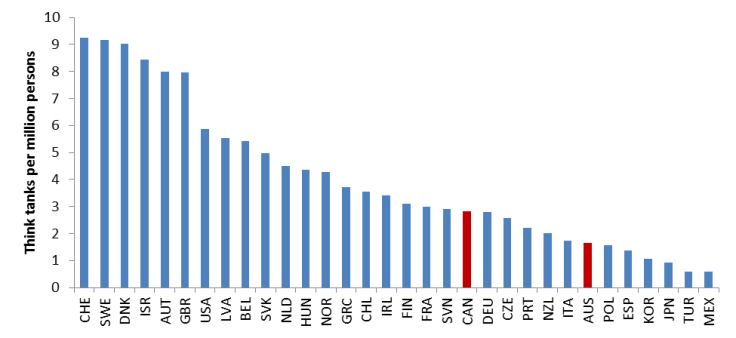
In per capita terms, Australia’s has about 1.7 think tanks per million persons. In contrast, the US — which has more think tanks than any other country in the world (1872) — has more than three times this, 5.9 per million persons.
We might think that driving the US’s numbers are the differences in the complexity of our economic structures, institutional settings and the extent to which policy formulation is conducted in or outside the government tent. Yes, they’re probably contributing factors, but we’re still low. Our Canadian cousins for example, with their like economy, institutions and penchant for government, have almost double the number of think tanks per capita that we do. Actually, across the OECD, its only the Japanese, Koreans, Spanish, Mexicans, Turkish and Poles that have fewer.
Think tanks per million persons, OECD 2017
Notes: Excludes Iceland, Estonia and Luxemburg which were outliers that messed up my chart.
Source: Go To Global Think Tank Index and Penn World Tables.
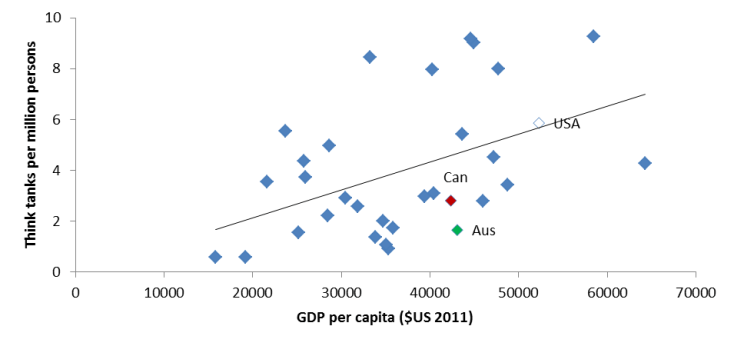
As further evidence of a missing market, the number of think tanks per capita tends to rise with living standards (no causality implied). Given Australia’s living standards, we would expect that the number of think tanks to be closer to the 100 mark — more than 2.5 times what we actually have. Interestingly, while there is a relationship between income and the number of think tanks, the size of the government sector has almost no predictive power.
Think tanks per million persons by income per capita, OECD 2017
Notes: Excludes Iceland, Estonia and Luxemburg which were outliers that messed up my chart.
Source: Go To Global Think Tank Index and Penn World Tables.
Are we missing out? Does the quality of Australia’s public policy debate suffer by not having a fifth estate?
Well, on the one hand, we’ve compensated for this gap by building institutions like the Productivity Commission and ISA. Industry Growth Centres, in their capacity to provide thought leadership and strategic vision to their sectors, also play a role. The Canadian Government’s Economic Strategy Tables provide a template for future hole plugging. The six Tables, launched in the 2017 Budget, are “a new model for industry-government collaboration… [that] will set ambitious growth targets, identify sector-specific challenges and “bottlenecks”, and lay out an actionable roadmap to achieve their goals”.
We also have to remember that Australia is not an island (errr…). Ideas and knowledge aren’t constrained by national borders. We can — and do — learn from think tanks outside of our jurisdiction.
But on the other hand, the driving motivation for a think tank is to be influential. They’re all about being listened to. The thicker is the market, the more competition they face, and the more they have to fight to be heard. Winning the contest of ideas requires a think tank to be novel, robust and relevant. And in this vein, the absence of a fuller think tank community would indeed seem to suggest that we are missing out on a source of innovative solutions to local problems.
Post script: It would be remiss not to acknowledge that there are those that warn against an ideas industry that’s too powerful and too influential. Here’s a podcast featuring Dan Drezner on the economics of the ideas industry and the rise of the thought leader.
 TALES FROM THE LONG TAIL
Leave a comment