
Figures came out yesterday reporting the 16th month of consecutive jobs growth. That’s the longest streak on record. In fact, you’d have to go back over 20 years to find anything comparable (there was a 15 month streak that ended in July 1994).
The number of Australians employed now stands at 12.5 million — spot on half the population.
Of the other half, a fair chunk are either children (4.6 million) or aged over 65 (3.5 million). Which leaves about 4 million that are of working age, but aren’t working.
The majority of these are not unemployed. Being unemployed has a specific meaning, requiring the individual to be actively looking for paid employment. The unemployment rate is a low 5.6 per cent, which accounts for about 700 thousand persons.
Rather, the majority of those out of the workforce are students, stay at home parents, gap-yearers, artists, early-retirees and the ever growing cohort of 20-somethings that are still living at home.
As the economy ebbs and flows so does participation in the workforce. This is particularly so for youths and olds. Full time study might seem less attractive when the trade-off is a high paying job offer. Low wages and a lack of job opportunities might make early retirement more attractive.
Those of prime working age (persons aged 25-55) meanwhile, are a much more stable cohort. And the extent to which they are employed is a good yardstick for the health of the economy.
The share of PWA-ers with a job has been creeping up for as long as the ABS has data. In 1978, around 70 per cent of PWA-ers had a job. Today — in most part because of the rise of female employment — its more than 10 percentage points higher.
Every time we have a recession, PWA employment takes a hit. After the 1981 recession for example, the share of PWA-ers employed fell by 4 percentage points and took five years to recover. After the 1991 recession, the drop was both bigger (5 percentage points) and the economy took longer to bounce back (nine years).
The most recent drop in PWA employment was caused by the GFC. 81 per cent of PWA-ers were employed in December 2008. Weak market conditions saw the rate fall below 78 per cent by January 2014. 3 percentage points might not sound like a lot, but it equates to roughly 250 thousand jobs.
PWA employment remained below pre-GFC levels for 105 consecutive months, only breaking through in October last year. In the US, it is still “noticeably below” pre-GFC levels and the Fed Reserve is worried about permanent shift in the labour market.
PWA-ers with a job
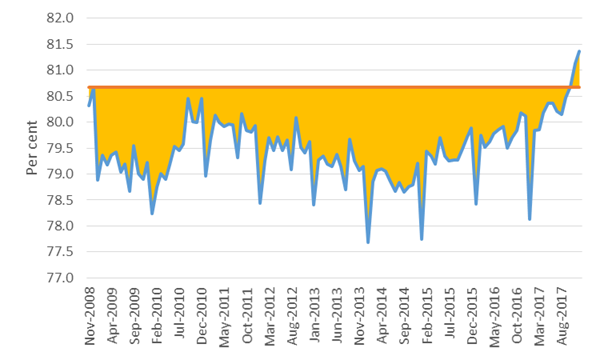
Source: Josh, Kristel and the ABS.
Counterintuitively, while the number of jobs has grown considerably in recent years, and the unemployment rate remains low, we haven’t seen any increase in real wages for about a decade. Indeed, there doesn’t appear to be much pressure on wages to rise at all.
One potential explanation for this lies in the stunted recovery of PWA employment. It’s taken quite a while for everyone to get back to work, and with so many workers waiting on the sidelines, employers haven’t felt the need to offer higher wages to attract workers.
The chart above however, would seem to suggest that that’s all about to change…
Post script: Obviously PWA is a terrible acronym. I’m open to suggestions.
UNCLASSIFIED
 TALES FROM THE LONG TAIL