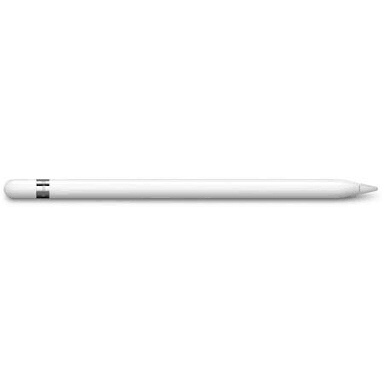
I am an iPencil — the high tech stylus designed familiar to all boys and girls and adults who can browse the Internet and post to social media.
Writing is both my vocation and my avocation; that’s all I do.
You may wonder why I should write a genealogy. Well, to begin with, my story is interesting. And, next, I am a mystery — more so than a tree or a sunset or even a flash of lightning. But, sadly, I am taken for granted by those who use me, as if I were a mere incident and without background. This supercilious attitude relegates me to the level of the commonplace. This is a species of the grievous error in which mankind cannot too long persist without peril. For, the wise M. Parkinson warns against “the fatal combination of arrogance and ignorance.”
I, iPencil, simple though I appear to be, merit your wonder and awe, a claim I shall attempt to prove. In fact, if you can understand me — no, that’s too much to ask of anyone — if you can become aware of the miraculousness which I symbolize, you can help save the freedom mankind is so unhappily losing. I have a profound lesson to teach. And I can teach this lesson better than can an electric vehicle, or a quantum computer or an algorithm that employs machine learning because—well, because I am seemingly so simple.
Simple? Yet, not a single person on the face of this earth knows how to make me. This sounds fantastic, doesn’t it? Especially when it is realised that there are about 2.5 million of my kind produced through elaborate global value chains each quarter.
Pick me up and look me over. What do you see? Not much meets the eye — there’s some plastic, a bit of metal, a nib made of rubber, a lighting adaptor and technologies that are beyond comprehension for the average person.
Innumerable Antecedents
Just as you cannot trace your family tree back very far, so is it impossible for me to name and explain all my antecedents. But I would like to suggest enough of them to impress upon you the richness and complexity of my background.
My family tree begins with what in fact is an idea, the continuation of over a decade of innovations that began in a garage in Los Altos in 1976.
Now contemplate all the university research, defence contracts and the countless other sources of government as assistance that helped commercialise my invention. Think of all the persons and the numberless skills that went into their design: the university professors and teaching assistants, the coders and engineers and the university bartenders; the market testing: the ad men and women, the focus groups; the financing: the bankers and insurance brokers and market analysts; and the supply chain optimisers: planning for assembly requires a complex understanding of how the microchips and casing will combine at the lowest possible cost. Why, untold thousands of persons had a hand in every cup of coffee the students drink!
Once designed and prototyped, orders are sent to a factories in the United States, Korea, Germany, France, Japan and China. Can you imagine the individuals who make flat cars and rails and railroad engines and who construct and install the communication systems incidental thereto? These legions are among my antecedents.
I’m designed in California. 43,000 engineers, coders, financiers and marketing experts working tirelessly to innovate and reinvent me. Here I am an idea, perhaps a prototype, but otherwise being imagined on a white board or in a virtual space. Sweepers at the Apple Campus among my ancestors? Yes, and included are the men and women who poured the concrete for the Gas & Electric Company which supplies the campus’ power!
Like my cousins the iPhone and the iPad, my component parts are sourced from countries all over the globe. They have their displays made in Japan and touch sensors made in Taiwan. More than 200 suppliers contribute to their construction. Each bringing specialist knowledge, the outcome of billions spent on research and development.
My “lead” itself — it contains no lead at all — is complex. It’s comprised of a logic board, an antenna, a ribbon cable and a lithium-ion battery. To make the battery, spodumene is mined and milled in Western Australia and turned into a concentrate. This is then shipped to China, or perhaps Malaysia, to be further processed and have the lithium extracted as industrial salts and chemicals. Consider these miners and those who make their many tools and the makers of the sacks in which the lithium is shipped and those who make the string that ties the sacks and those who put them aboard ships and those who make the ships. Even the lighthouse keepers along the way assisted in my birth — and the harbor pilots.
Once in the Foxconn factory — hundreds of millions of dollars in machinery and building, all capital accumulated by thrifty and saving parents of mine — each part is assembled through a combination of robotics and human effort, a process which has no doubt been optimised by operations specialists and technical engineers. Here you’ll find 230,000 of my aunts and uncles working 12 hour shifts, before returning to their dorm in Foxconn city.
Observe the labelling and the marketing. I’m called a “magic wand”, a term that no doubt tested well amongst my carefully selected ancestors in Apple’s focus groups. My sleek and simple design embodies decades of investment in intangible capital.
My bit of metal — the ferrule — is the only common feature I share with my older self.
No One Knows
Does anyone wish to challenge my earlier assertion that no single person on the face of this earth knows how to make me?
Actually, millions of human beings have had a hand in my creation, no one of whom even knows more than a very few of the others. Now, you may say that I go too far in relating the picker of a coffee berry in far off Brazil and food growers elsewhere to my creation; that this is an extreme position. I shall stand by my claim. There isn’t a single person in all these millions, including Tim Cook, who contributes more than a tiny, infinitesimal bit of know-how. From the standpoint of know-how the only difference between the coder in Palo Alto and the factory worker in Shenzen is in the type of know-how. Neither the coder nor the factory worker can be dispensed with, any more than can the ad men and women in Manhattan.
Here is an astounding fact: Neither the coder nor the engineer nor the factory supervisor nor the clerks at the Genius Bar nor the CEO of the company performs her singular task because she wants me. Each one wants me less, perhaps, than a toddler with screen-time. Indeed, there are some among this vast multitude who never saw a tablet nor would they know how to use one. Their motivation is other than me. Perhaps it is something like this: Each of these millions sees that she can thus exchange her tiny know-how for the goods and services she needs or wants. I may or may not be among these items.
No Master Mind
There is a fact still more astounding: the absence of a master mind, of anyone dictating or forcibly directing these countless actions which bring me into being. No trace of such a person can be found. Instead, we find the Invisible Hand at work. This is the mystery to which I earlier referred.
It has been said that “only God can make a tree.” Why do we agree with this? Isn’t it because we realize that we ourselves could not make one? Indeed, can we even describe a tree? We cannot, except in superficial terms. We can say, for instance, that a certain molecular configuration manifests itself as a tree. But what mind is there among men that could even record, let alone direct, the constant changes in molecules that transpire in the life span of a tree? Such a feat is utterly unthinkable!
I, iPencil, am a complex combination of miracles: plastics, zinc, copper, silicon, lithium and so on. But to these miracles which manifest themselves in Nature an even more extraordinary miracle has been added: the configuration of creative human energies — millions of tiny know-hows configurating naturally and spontaneously in response to human necessity and desire and in the absence of any human master-minding! Since only God can make a tree, I insist that only God could make me. Man can no more direct these millions of know-hows to bring me into being than he can put molecules together to create a tree.
The above is what I meant when writing, “If you can become aware of the miraculousness which I symbolize, you can help save the freedom mankind is so unhappily losing.” For, if one is aware that these know-hows will naturally, yes, automatically, arrange themselves into creative and productive patterns in response to human necessity and demand — that is, in the absence of governmental or any other coercive masterminding — then one will possess an absolutely essential ingredient for freedom: a faith in free people. Freedom is impossible without this faith.
Testimony Galore
If I, iPencil, were the only item that could offer testimony on what men and women can accomplish when free to try, then those with little faith would have a fair case. However, there is testimony galore; it’s all about us and on every hand.
The lesson I have to teach is this: Leave all creative energies uninhibited. Merely organize society to act in harmony with this lesson. Let society’s legal apparatus remove all obstacles the best it can. Permit these creative know-hows freely to flow. Have faith that free men and women will respond to the Invisible Hand. This faith will be confirmed. I, iPencil, seemingly simple though I am, offer the miracle of my creation as testimony that this is a practical faith, as practical as the sun, the rain, a cedar tree, the good earth.
Post script: The original I, Pencil is a beautiful piece of poetry and my apologies for the treatment above. The original text is here, there’s a YouTube movie version here and an old Freakonomics podcast here.
 TALES FROM THE LONG TAIL