
The map below is a composite image of the Earth at night. It’s been produced using photos taken from 312 orbits of the planet to get enough using cloud-free satellite images to get a clear shot of every parcel of Earth’s surface.
The earth at night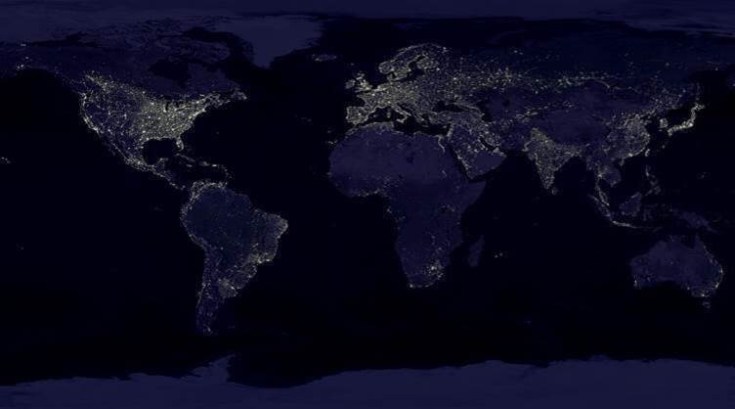 Notes: If you want to see something really amazing, check out the WA bushfires visible in this image.
Source: NASA.
The image provides a map of global economic activity. As might be expected, the USA, Western Europe and Japan shine brightly, as do pockets of China and India. Elsewhere, entire continents remain in almost total darkness. (Many more regions would be blacked out were these photos taken a generation ago.)
The stark concentration is no accident. Cities provide “agglomeration economies” — benefits that arise from colocation. The only real difference between a nearby firm and one far away is that it is easier (cheaper) to connect with a neighbour. While the cost of moving goods has declined enormously over the last century, the cost of moving people remains high. Moreover, as productivity increases, the time-cost of moving people from one location to another increases as well. This is why cities are not just growing in size, but are also becoming denser.
Shining brightest are the world’s global cities — London, New York, Paris, Tokyo, Sydney and Melbourne. Truly engaging with the global market place requires more than just a port and an airport (although these are important). Engagement also requires a critical mass of services like finance, marketing and management consulting to facilitate and contribute to the products being exported, particularly so in knowledge-intensive industries. In value-added terms, services make up almost half of Australia’s exports (see table below). By lowering the costs of connection, cities increase the efficiency of business services, allowing for higher levels of trade.
Share of gross and value added exports, 2016, per cent
| Industry | Gross exports | Value added exports |
| Agriculture | 4.3 | 5.2 |
| Mining | 43.9 | 33.9 |
| Manufacturing | 24.9 | 11.6 |
| Construction/Utilities | 0.5 | 4.8 |
| Services | 26.4 | 44.5 |
| Total | 100.0 | 100.0 |
Notes: Gross exports refer to the final value of the product being traded. Value added exports account for the intermediary contributions made by different industries to final value. For example, a significant amount of services are used in the extraction, transport, marketing and sales of Australia’s mining exports. When accounting for value added, the cost of these intermediary services are subtracted from mining exports and added to services exports.
Sources: 2016 WIOD; OCE forthcoming
In addition to being a map of global economic activity, the image is also a map of global innovative activity.
All the ingredients needed for a prosperous innovation system can be found in a city: diversity, scale, networks and talent. Different people, working on different things, colliding together in unexpected ways is what brings about new ideas. The interactions and information exchange through social networks are often the driving force for idea-creation, productivity and individual prosperity. A 2010 study, found that when the population of a city doubled, economic productivity grew by an average of 130 percent.
Further driving concentration into cities is the mutually reinforcing relationship between trade and innovation. Firms that innovate become more productive and competitive — a precursor to entering a foreign market. While, firms that export obtain knowledge and technologies that help to innovate. OCE research showed that innovating firms are 4-8 per cent more likely to export, and firms that export 7-10 per cent more likely to innovate.
The beauty of all this is the spillover benefits from trade, innovation and city policy efforts. Policies that seek to improvements in one should create a dividend for the other two.
* This is an insight that’s coming out in the soon to be released Australian Industry Report. For more information click here.
 TALES FROM THE LONG TAIL

Leave a comment