
This is from a talk I gave at the PhillipKPA National Apprenticeships Forum in Sydney this week. It draws heavily on the materials I’ve been sharing through these emails. Slides are attached. Sorry it’s a bit long, but it’s worth it for the chart at the end.
Thank you for having me here today. I’ve been asked to talk about what I expect the labour market in the future to look like.
Short answer is I don’t know. Prediction is very difficult, particularly when it’s about the future.
What do we hear?
Some people though, are a lot more confident than I am. And it’s often a pretty gloomy outlook.
They say:
• There won’t actually be any jobs. Technology is automating everything and taking away all the work. The only jobs left will be a handful of app developers, or low skilled jobs like cleaners.
• Goodbye to that sense of security. Permanent jobs are on the decline. The workforce is becoming increasingly casualised and gigified.
• And lastly, they say, the pace of change is quickening. That the future will be here before you know it.
I thought what I might do, is look at these propositions and test whether there’s any merit to the arguments.
What do we know?
I’ll start with what I think we do know.
First, there’ll be more of us. We’ll be richer. And we’ll be older.
Australia has the second fastest population growth rate in the OECD. The ABS expects that by 2030, our population will have swelled to 30 million. Almost 20 per cent of which will be aged over 65 (that’s up from 15 per cent today). In the mix, there’ll also be an extra 250 thousand persons aged over 85.
We should be richer too. Over the last 25 years, our per capita incomes have grown from $32.5k to $53.5k. That includes the mining boom, but it also includes the last 10 years since the GFC when income growth has come to a halt. But let’s say trend continues. By 2030 incomes should be around a third higher than they are today. More if productivity gets a boost, less if it doesn’t.
I don’t know what impact technology will have, or when, but I think it’d be remiss to think that it won’t have any impact. Big data, IoT, VR, augmented reality, 3D printing. Will change what and how we produce and consume.
Whereas previously you may have been a manufacturer of toys, or bikes or weapons. 3D printing capabilities will mean that on Monday you print toys, on Tuesday its bikes and Wednesday its weapons.
Re consumers, we often think of big data informing big firms. But consumers are winners here as well. The plethora of comparison sites and rating sites, mean that consumers have never been so informed. I chose where to get my coffee this morning based on a Yelp rating.
Finally, we’ll be more connected. Technology crossed with globalisation is seeing the greater and greater development of global value chains. Niches are becoming increasingly important.
As much as 75 per cent of global trade is in intermediary goods. Highly optimised global value chains see production tasks sliced up and assigned to those countries that can provide the greatest efficiencies.
• iPhones consist of parts from 200 suppliers
• The new Boeing 787 Dreamliner is made at 135 different production sites across the world
• Salmon that’s caught in the US is snap frozen, shipped to China, thawed, deboned, snap frozen and shipped back to the US.
Competitive pressures are only going to get stronger.
We can see this already in the data
Nothing here is anything new. The economy has been feeling the effects of these forces for decades.
The economy is becoming increasingly servitised, digital and pink.
• Servitised — One in three jobs used to be in primary industries, now only one in twelve. 10 years ago, manufacturing was our third largest industry. Now its 6th after health, retail, construction, professional services and education. And its shrinking.
• Digital — If you split jobs into physical and digital, where physical jobs are the ones that either make something, or the service provided requires (for the most part) the provider to be present (eg health and education); and digital jobs are those where the service can be done anywhere — professions, finance etc. Growth in the number of digital job has outpaced physical jobs by about 1 per cent per year for the last two decades.
• Pink — Those occupations/industries that have been traditionally female dominated — childcare services, preschool education, medical services, retail — are the ones that are growing the most. In fact, the pinker the sector, the faster the rate of employment growth. Industries that have traditionally been at least 50 per cent female grew by 26 per cent over the last decade; 70 per cent female grew by 31 per cent.
Now lets go back to the propositions
“44 per cent of jobs have the potential to be automated”
First was, “there will be no jobs”.
This fear/statement/proposition comes from the notion that technology will replace the need for human labour. We’ve seen countless examples of where this is true. Automobiles replaced the horse, radios replaced the home piano, word processors replaced the typist, MYOB replaced junior accountants, ATMs replaced bank tellers. And so on.
This chart is typical of the evidence used to support this type of argument. It plots the number of persons employed against their automation potential. About 44 per cent are in the high range.
Distribution of Australia’s workforce by automation potential

Source: Edmonds and Bradley 2015.
Some of these occupations are low skilled, increasingly they are not. These studies look for tasks that are routine and repetitive. Tasks that can be codified. More and more these are the pharmacists, accountants, paralegals.
There will be jobs
Technology impacts on the workforce in a few different ways.
• As a substitute. Which is what everyone is worried about. The introduction of the automobile for example put out of work thousands in the equestri-transportational sector. The drivers, the stable hands, the blacksmiths, the cleaners employed to pick up after the horses.
• But it also spawned industries that were complementary. Such as auto assembly workers, mechanic, panel beater and so on.
• And probably the bigger impact were the jobs created in new industries. Tourism experienced a huge boom for example. Roadside motels became a thing, as did drive through fast food. Auto insurance, road construction. All these industries — many unexpected — emerged as a result and employed thousands more than were originally lost. And did so with higher levels of productivity.
The argument that jobs will be lost to robots is known as the lump of labour fallacy. And similar arguments have been used to guard against trade and migration. It assumes there is only a fixed lump of work to be done. It can either be done by humans or machines. Lump of labour thinking fails to recognise how productivity growth leads to job creation.
Productivity gains in the form of process improvements lower production costs. Lower production costs lead to lower prices. Lower prices stimulate increases in demand. Greater consumption encourages greater production. And more production means more jobs.
So far, history has shown that we’re pretty good at finding new uses for human labour. The first industrial revolution for example, did not eliminate the need for human workers. On the contrary, they created employment opportunities sufficient to soak up the 20th Century’s population explosion. The diffusion of ATMs lowered banks’ operating costs and freed up clerks to provide more complex services to customers — resulting in an increase in employment in the banking sector. Drones may disrupt the transport and delivery sector, but someone will have to install and service all the drone nests needed to accommodate them.
Australia’s automation “risk” is actually falling – I’ll come back to why later.
Some gigification, but probably not that much
The gig economy. The gig economy is another buzzy phrase people like to deploy.
In the gig economy positions are temporary and workers are engaged on independent contracts for short-term engagements. I’ve seen one study that suggests by 2020, 40 percent of American workers would be independent contractors.
Let me talk about the gig economy from a demand perspective. Why are sites like Airtasker so popular with consumers? Consumers are dissatisfied with the prices and quality of services offered by traditional businesses. They want better service, more tailored solutions. Matchmaking technologies provided by smartphone apps and other websites, allow consumers virtually instant access to services, and firms to “contingent workers”.
Proponents of the gig economy argue that this allows entrepreneurship and opportunities for people to advance their careers based on their abilities, rather than through long service, firm loyalty or “time-serving”.
That all sounds great. But… we’re not really seeing it. At least not in Australia.
The proportion of the workforce employed casually hasn’t changed in about 20 years. Part time employment seems to be responsive to changes in the business cycle.
And the proportion of the workers that are self-employed continues to fall. Australia’s self-employment rate is 10.1 per cent — 1.2 million persons.
Interestingly, and don’t ask me why because I don’t have a good answer, the rate of self-employment in the UK has been climbing for near two decades. The rates of self-employment in the UK and Australia were actually about equal in 2005, but since that time the two have diverged by 20 per cent in each direction. The absolute number of self-employed in Australia hasn’t moved since the start of the millennium.
Figures came out of the UK last month that placed their unemployment rate at 4.3 per, the lowest it’s been in 42 years. The UK’s unemployment rate has falling steadily since 2011, when it peaked at 8.4 per cent. More than 2.5 million jobs have been created in that time — around a third of which have been self-initiated.
I suspect we’ll some increase gigification, particularly in some areas, but I don’t think it’ll be as widespread as is often made out.
We will recognise the future
“The pace of technological change is speeding up.”
Yes sometimes it feels like that, but other times it doesn’t.
There is a big debate in the literature about just how big and quick the changes in technology will be. On the one hand you have your techno-optimists like McAfee whose line is “we haven’t seen anything yet”. And on the other Robert Gordon, who points out that each preceding industrial revolution – steam, electricity and communications – has resulted in a smaller impact.
For hundreds of years preceding say 1870, there was next to no technological improvements. The world in 1870 looked essentially the same as it did in 1570. No running water, dirt roads, horse drawn transport. The tallest building in the town was the church. Fast forward 70 years, by 1940 we have sewers, subways, aeroplanes, intercontinental communications, automobiles, freeways, radio, fridges, air-conditioning. The tallest building in the land was now the Empire State Building.
We’re now a little more than 70 years into the future. What’s changed? Computers and the internet. Big gains there. But the car, while improved in many ways, is still recognisable. So are the planes, the sewers and the buildings. I’m not trying to diminish the incredible gains that have occurred over this time, I just want to make the point that going from no phone to phone is a bigger deal than going from iPhone 7 to iPhone 8.
Now there is some evidence that pace of change is picking up. The telephone was invented in 1876, but it took decades before penetration hit 50 per cent. 80 per cent was not reached until the 1960s.
What took the landline half a century, took the mobile phone half a decade.
That’s true of a lot tech, and I’m thinking will be true for a lot of the tech still to come. It’s being enabled by rising incomes, infrastructure, skills. It’s also a factor of the technology’s incrementalism.
If we are living in a period of unprecedented technological change, then perhaps I’d expect this to materialise as unprecedented levels of disruption.
But no. A study by the Information Technology and Innovation Foundation, a US think tank, looked at the rates of occupational churn since 1850. Occupational churn here, measures the absolute number of occupations rising and falling as a share of overall job growth. Controlling for population growth, how much disruption is there in the labour market.
According to this study, the rate of churn is now the lowest its been since 1850. I don’t have a data set that goes anywhere near that length, but from my calcs, Australia is showing a similar trend over the last few decades.
Robert Gordon, likes to play a game called find the robot. Wherever he is, travelling, shopping, eating at a restaurant, he asks why are there still so many people here? How different is the retail sector today from 2007? From 1997? From 1987? Yes we have some online shopping (not yet really that large), self-service checkouts – in some large retailers, and more efficient back offices. But the biggest difference in my experience buying a suit today versus 30 years ago, is going to be the size and style, and price. My interactions with the store will be mostly the same.
Gradual technological incrementalism will mean that how the jobs of the future, will be a little different to what they are today. Those tasks that we can delegate to a robot we will, and humans need to fill the gaps that computers cannot master.
Skills will earn a premium
The final point I want to mention is about skills.
Let me go back to a point I was making earlier about automation.
We did some work in 2015 that showed the automation potential of the Australian workforce is falling. New technologies may have the potential to change that, but given what’s in the near future, the potential is falling.
This is a numerator/denominator issue. Over say the past decade jobs have been automated. So those jobs are no longer in the workforce. And the new jobs being created are typically the ones that are less susceptible.
Rather than really being a finding about automation potential, this really provides some insight about skill demand. The way the measure is created, is that it looks at the extent to which an occupation employs social, perceptive and creative skills – things which computers cannot do.
What we are seeing is a rise in the demand for social skills, problem solving, relationship building and creativity.
Humans will always have a comparative advantage in being human.
As technology advances further, becomes cheaper and more widespread, jobs will change.
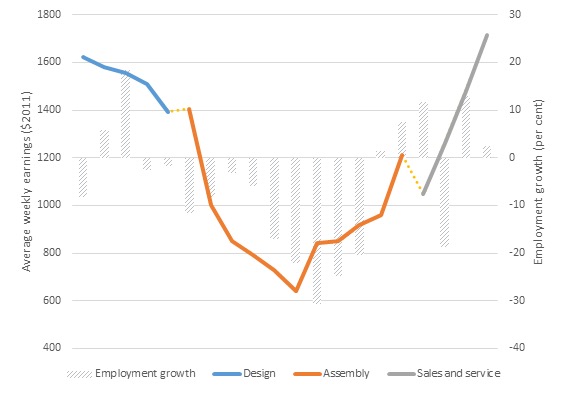
This is a really cool chart that shows what’s going on in the manufacturing sector.
The smile curve, manufacturing, 2011
Source: Forthcoming in the AIR 2017.
Along the bottom are occupations employed in the manufacturing industry – they relate to design, production and sales. The vertical is their average earnings.
This is what’s referred to as the smile curve. Manufacturing is more than just the assemble line. It spans R&D, materials, production, logistics, sales and service.
This curve shows that most of the value is at the ends. The bars behind show employment growth over the 5 years to 2011, emphasising the point.
What’s happening here, and why the ends of the smile are rising, is because consumers are more demanding. Technology (and global forces) are allowing that to happen. They are being empowered. Customers are not settling for “one size fits most”. They want things tailored and specific. They want it yesterday. And they want it delivered. And if you can’t get it for them, they can find someone who can.
That’s the world in which the labour markets of the future are probably going to need to operate in. And it most likely will require a somewhat different skillset to what was required yesterday.
So that’s the end of what I had to say, hopefully you found that useful, and perhaps comforting.
 TALES FROM THE LONG TAIL
Leave a comment