
Australia’s near 26 years of continuous economic growth is something to be proud of. Our growth run has been helped along by microeconomic reforms in the 1990s, the rise of China, a once in the lifetime commodity price boom and one of the fastest population growth rates in the developed world.
And in addition to that we’ve worked really hard.
Really, really hard in fact. Australians are working more than 6 million more hours a year than they were 25 years ago — a 45 per cent increase. In comparison, American hours are only up 27 per cent.
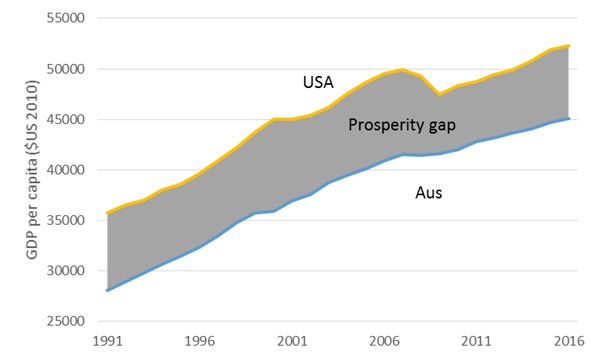
The average work week in America has typically been longer than in Australia, but this is changing. Australia’s “labour effort gap” (the difference between hours worked per person in the US and in Australia) fell from about 70 hours a year in 1991 to about 25 hours a year today. Labour effort, which measures the number of hours worked per year, per person, has increased not because we’re working longer weeks per se, but because more people are participating in the workforce more, and our unemployment rate has fallen. For a brief period after the GFC (when US unemployment was high), Australians were typically working more hours.
Australia’s labour effort gap, 1991-2016
Source: OECD
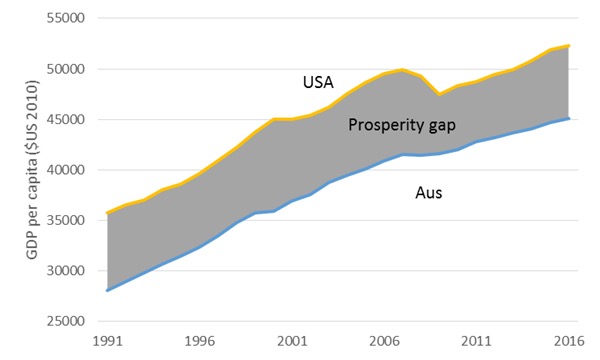
While we’ve closed much of the labour effort gap, each hour worked in Australia creates between $6 and $11 less value than it does in the USA. This is our “productivity gap”. Productivity (GDP per hour worked) growth has been marginally faster in Australia, but by no means enough to bring equality with the US. Interestingly, our productivity gap has persevered despite improvements in communications technologies, which should help spread of knowledge and innovation across the globe.
Australia’s productivity gap, 1991-2016
Source: OECD
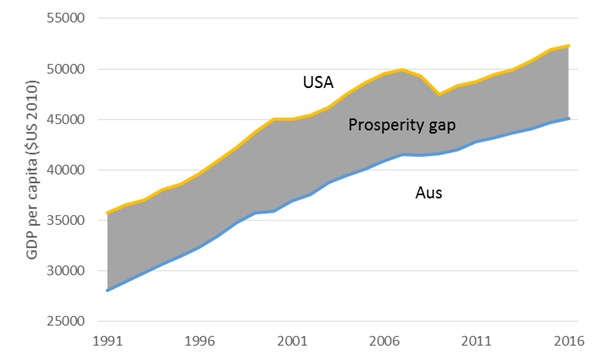
The labour effort gap and the productivity gap combine to become the “prosperity gap”. Given that we both work less, and work less productively, it shouldn’t then be a surprise that Australia’s per capita GDP is also lower. Per capita GDP in Australia is about $7200 lower than in the US (measured using constant $US 2010 dollars). The prosperity gap has closed over the last 25 years — at the start of the period Australia’s GDP per capita was 22 per cent lower, today it is only 14 per cent — mostly because of increasing labour effort (though it is worth noting that much of the narrowing has occurred because of falling hours in the US).
Australia’s prosperity gap, 1991-2016
Source: OECD
Productivity reflects our ability to produce more output by better combining inputs, owing to new ideas, technological innovations and business models. As the difference between Australian and US labour effort dwindles away, productivity now almost wholly explains the remaining differences. Right now we have to work harder than our American counterparts to generate the same amount of value. Indeed, of those countries with greater per capita incomes than ours — Luxemburg, Ireland, Norway, Denmark, USA, Netherlands, France, Germany, Sweden and Austria — only the US and Ireland work more hours on average. The rest are all working smarter.
 TALES FROM THE LONG TAIL
Leave a comment