
“You can see the computer age everywhere but in the productivity statistics.” (Solow, 1987)
Computing capacity in United States increased a hundred fold between 1970 and 1980. Firms invested heavily into IT kit at record levels, and in 1982 Time Magazine named the computer the Person of the Year.
Yet, despite this, productivity growth slumped in most countries. Productivity growth averaged about 3 per cent going into the 1970s and left the 1980s at around 1 per cent.
The circumstances that led Solow to make his famous quip are eerily familiar today. Ground breaking developments in AI, the IoT, quantum computing, analytics etc are being made every day. Yet, paradoxically, productivity growth remains low across the globe.
Some economists have argued (quite convincingly) that it’s highly unlikely that we’ll see a return to such rapid productivity gains. But there’s also good reason to the think why the future might not look so gloomy.
The parts of the economy that are the most embracing of technology are those industries where the main output can be easily provided in a digital form, and readily delivered anywhere in the world. These digital industries include information, media and telecommunications, finance, professional services and administrative services.
In contrast, physical industries are those with an output mostly provided in physical form. These industries include agriculture, mining, manufacturing, utilities, construction, wholesaling, retailing, hospitality, rental services, transport, safety, education, health, recreation and other services. The bulk of the economy falls into the physical industries.
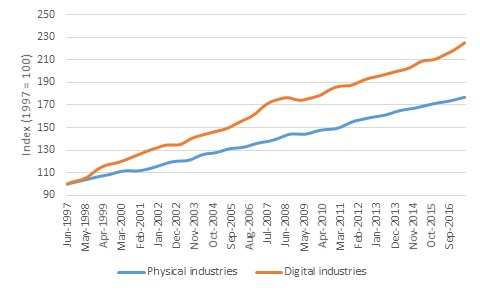
Over the past 20 years, growth in productivity, employment and output has been much faster for digital industries than for physical. Digital industry productivity for example, grew by an average of 2.0 per cent a year, compared to 1.4 per cent in physical industries. The charts below show the runaway gap in performance of the digital industries.
Productivity growth — digital and physical industries
Source: Methodology is based on Mandel and Swanson (2017), data is from ABS.
Employment growth — digital and physical industries
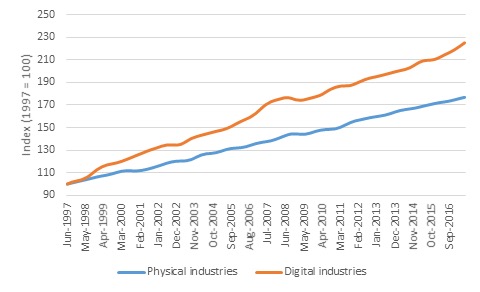
Note: Employment here is measured in terms of hours worked.
Source: Methodology is based on Mandel and Swanson (2017), data is from ABS.
Output growth — digital and physical industries

Source: Methodology is based on Mandel and Swanson (2017), data is from ABS.
The difference in employment growth (measured here in hours worked) is worth noting, particularly as it runs counter to claims about how technological disruption destroys jobs. There are 53 per cent more jobs in digital industries than there were 20 years prior, compared to 35 per cent more jobs in the physical industries. One likely explanation for this is that as technology costs have fallen, the demand for digital outputs (and the workers required to produce them) has increased.
A key difference between digital and physical industries is not just the nature of their outputs, but also their use of technology. Mandel and Swanson estimate that digital industries in the US account for about 70 per cent of private sector infotech investment. In Australia, digital industries are 59 per cent more likely to have invested in new digital technologies and infrastructure.
Physical industries are the core of the economy. They account for about 80 per cent of the Australian workforce and nearly 70 per cent of our output. To the extent that this core is unplugged however, digital catch-up has the potential to significantly bolster productivity.
Post script: Looking back, the computer’s enormous economic potential seems obvious. And the good news is that not too long after the Solow made his comments, the investment in IT started to pay off and productivity soared.
 TALES FROM THE LONG TAIL
Leave a comment