
Across the economy firms are using digital technologies to varying degrees. At one end of the spectrum we see firms using websites of varying qualities, and maybe sending out the occasional tweet. At the other, we see firms that have installed digital sensors up and down the supply chain, are collecting data on millions of customer interactions and are using artificial intelligence to determine what product lines to promote and which to terminate. The gap between those who are and are not participating in the digital economy is wide, and potentially growing.
This variance is characterised by the differences in a firm’s “digital maturity”. Digital maturity is the extent to which a business uses digital technologies to improve its performance and competitive advantage. It reflects both the level of technology investment and usage, as well as the management capabilities needed to create digital transformation within an organisation.
McKinsey’s Industry Digitization Index provides a measure of digital maturity in the US. It combines 27 metrics (categorised as digital assets, usage and labour) and reports results for 22 sectors in the US economy. Their 2015 analysis listed ICT, Media and Finance as the most mature, while health care, construction and hospitality among the least.
How does Australia compare? This issue was looked at in last year’s Australian Industry Report. Well sort of anyway. Data limitations meant that we couldn’t say too much (about half the chapter is devoted to measurement issues). We ended up concluding that being digital was probably really important, but we didn’t know how important. We also didn’t really know who was and was not connected? If there is a digital divide, how big is it?
The ABS’ 2016-17 Business Use of Information Technology (BUIT) survey changes all that. The survey contains new data on how important different digital technologies are to firms, how they’re being used and how sophisticated is their use.
Using data from the BUIT survey, we can construct something similar to McKinsey’s Index and define a digital frontier for the Australian economy.
We can think of the digital frontier as being defined by those industries demonstrating best practice across 20 different indicators contained in the BUIT survey. For example, 96.2 per cent of medium sized finance firms place orders over the internet, 88 per cent of large arts firms receive internet orders and 87 per cent of large professional services firms use the cloud.
How close a sector is to the frontier can then be estimated by constructing a measure of “distance”. This distance to the digital frontier has been estimated different sectors and firm sizes in the chart below. The greater is the distance to the frontier, the less digitally mature is that sector. On the whole, Australian firms have some ways to go to meeting digital best practice — the average distance is 72 (out of a maximum 100).
Distance to the digital frontier, by industry and firm size, 2016-17
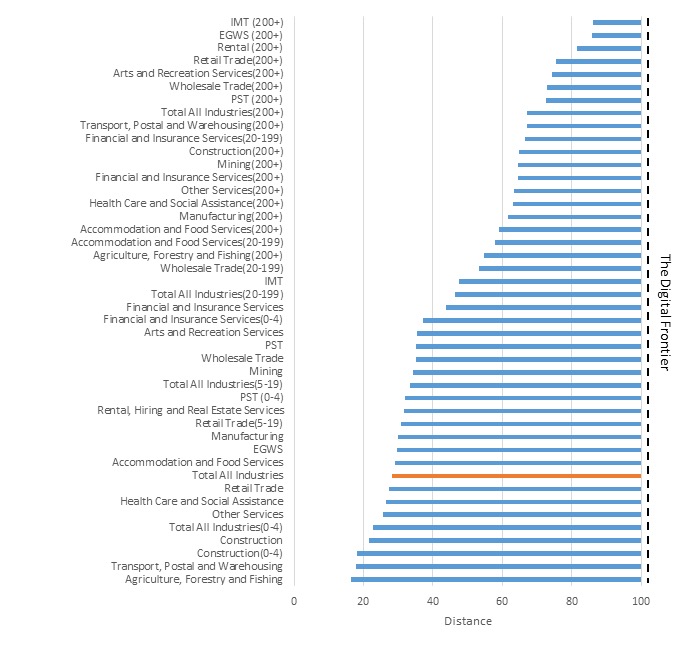
Notes: The frontier is calculated by normalising each indicator y to a common unit (max – y) / (max – min) for each industry/firms size observed. The aggregate distance score is then calculated by taking a simple average across all 20 indicators. It’s not perfect and this approach has some flaws. It’s also a lot cheaper than getting McKinsey to do it. Data was generally not sufficiently available to be able to comment on small firms at a sectoral level. However, given the firm size distribution of most industries (they’re all small firms) there’s not likely to be too much of a distinction between small firms and industry totals.
Source: Me, using data from the ABS BUIT survey. Excel file is attached.
Based on this analysis, agriculture is the sector that’s furthest from the digital frontier (84), while Information, Media and Telecommunications is the closest (53). Note that the frontier has been drawn using data that differentiates between small and large firms — and large firms are overwhelmingly more digital than are small. Firms that employ less than four persons are far from the frontier (77); while firms that employ more than 200 are very close (33). The firms closest to the frontier are large firms in the Information, Media and Telecommunications (14) and Utilities (14) sectors.
Not all sectors and firms in Australia are making full use of the potential of digital technologies. As a result, these firms are not as productive or efficient as they could be and risk being left behind. In contrast, digitally mature firms are using digital technologies in sophisticated and innovative ways to continually improve their performance and competitive advantage. Digitally mature firms appear to be in a strong position to take advantage of the opportunities offered by an increasingly connected and globalised economy.
 TALES FROM THE LONG TAIL
Leave a comment