
August was a big month on the technology timeline. At the start of the month Apple announced that it would be discontinuing production of its iPod Nano and iPod Shuffle. Then, mid-month the last Blockbuster Video stores closed down in Sydney and Canberra. And the ABS released the latest edition of the Business Use of Information Technology (BUIT) survey.
The BUIT survey collects data on exactly what you’d expect. But what makes it really interesting is how it has changed over time. Technology has come a long way since 1994, when the first survey was run, as has the way we use it.
The 1994 survey was mostly concerned with whether firms were simply using computers. Only about 50 per cent of Australian firms had a computer, according to the survey. Figure varied widely between industries, with computers being the most prevalent amongst firms in the utilities sector (85.9 per cent), and least prevalent in transport and storage (32.0 per cent). Computers were manned by specialist “computer users” that accounted for about 31 of their employees.
By 1998 the Internet had started to develop, and this was reflected in the second survey. Only 174 thousand firms had Internet access, the majority (92 per cent) using it for email. The second biggest use (23 per cent) of the Internet was for marketing and promotional purposes.
The rise of e-commerce sees questions included in the BUIT about the proportion of firms that either placed or received orders over the web from about 2000. Social media makes its first appearance in 2012, and cloud computing in 2014.
One of the more telling shifts in how firms used IT can be seen in the questions about Internet use. Whereas in the 1998 survey, businesses were asked if they simply used the Internet to place and receive orders, send and receive invoices and emails. A decade later, a business’ use of the Internet had become much more sophisticated and multifaceted. The 2008 BUIT survey asked if businesses were using the Internet to enable workers to work from home, gather information and conduct online learning /teaching. We see a similar maturity in questions about how firms used their website.
While the developments in the survey are fascinating, BUIT has always seemed a little basic – especially given the rapid, new developments of late. For the last 15 years, access to broadband Internet for example, has been near universal (95.3 per cent in 2016). While it is important to know who’s not connected, it’s also really important to understand about the firms that are.
In the latest release, the 2016 BUIT survey has been expanded to include questions about a broader suite of digital technologies (including the Internet of Things, RFID, AI and data analytics), as well as the consequence of cyber security attacks (33.5 per cent experienced lost productivity, 13.1 per cent reported a loss of income) and the role of management in introducing and implementing digital business strategies (6.5 per cent). The latter seems particularly useful in teasing out some as yet unanswered questions about digital technologies and productivity.
For the first time, we are now able to understand the importance of these different technologies to different sectors. We can compare for example, the extent to which digital technologies are used by say, the construction sector (not very much), with finance (a lot more) — see figure below. We can also understand which technologies are most important to different parts of the economy. Over time, we’ll be able to watch how different technologies impact on the economy as well as locate the digital leaders and laggards.
Digital technologies that are at least “moderately important”, 2015-16, selected industries
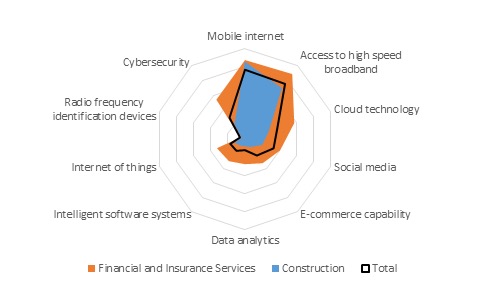
Note: Shows the proportion of firms within a sector that identified the technology as being either moderately or majorly important. In general, technology was most important to finance and insurance services firms, and least important to construction. The outer rim of the chart is 100 per cent.
Source: Business Use of Information Technology, 2015-16.
When it comes to the digital economy, we haven’t been flying totally blind. But a combination of missing information and hyperbole has certainly left us vision impaired. The latest BUIT survey will provide some much needed clarity.
Post script: The Video Ezy website has an ambitious search function where you can type in your address and find the nearest store within five kilometres. No results.
 TALES FROM THE LONG TAIL
Leave a comment