Over the past five years, nearly 1.4 million firms have gone out of business. That’s roughly 275 thousand firms a year, or one every two minutes.
Thankfully, for the third straight year, that number has increased.
Think about all the reasons a firm goes belly-up. They’re no longer able to meet customer needs. They’re being outpriced by a competitor. They haven’t made smart investment decisions. They’ve been run by poor management. Simply put, they’re no longer competitive.
Uncompetitive, poorly managed, expensive firms that can’t meet customer needs are precisely the firms we don’t want in the economy.
To the contrary, the firms we want are those that are able to create businesses out of new technologies, identify new markets and global opportunities and respond to the whims of its customers.
While we’ve lost about 1.4 million firms, we’ve birthed about the same. About 317 thousand new businesses entered the economy last year. The lion share of them were small, typically management consultants, cafés and tradies.
A resilient and prosperous economy is a dynamic one. Labour and capital are not sedentary and habitual, but hungry and ambitious.
When a firm fails, their resources are freed to be used elsewhere in the economy. Their assets are sold and repurposed for more productive uses. Workers find employment in firms where their skills can be put to better use. It may be (and generally is) a painful process for the individual, this is exactly what we want to happen from a whole of economy perspective.
Indeed, high levels of firm entry and exit are a sign of a healthy, innovative economy. So it’s a bit worrying when we see trends like the one in the chart below. This chart shows a steady fall in the business churn rate over the past decade, and only recently has this trend appeared to have slowed.
Business churn, Australia and USA, 1996-2016
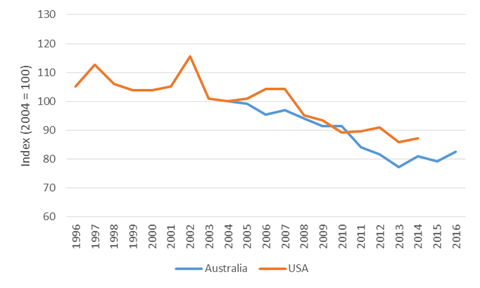
Note: Business churn is the number of business entries and exits expressed as a proportion of total businesses in a given year. Slightly different numerators and denominators have been used for US and Aus.
Source: ABS and US Census Bureau.
The downward trend in Australia’s business dynamism is a product of both declining firm entries and declining firm exits. In other words, the economy is generating fewer entrepreneurs, and is becoming more complacent in regards to the firms it keeps. Compounding this is a parallel story for jobs. Research released by ITIF earlier this year, shows that the rate of labour mobility in the US is the lowest it’s been since 1850. In Australia, the numbers aren’t as dramatic, but the numbers are still low.
Why is the economy becoming less dynamic? No one quite knows. The problem is a global one. Data from the USA is included in the chart to illustrate that that this trend is both international and long running.
What is well understood though, is the link between business dynamism, productivity and sustained economic growth. If the decline in dynamism persists, then we can probably expect economic growth to be uninspiring well into the foreseeable future. Reversing the downward trend will require policies that promote entrepreneurship on the one hand while disciplining underperformers on the other.
 TALES FROM THE LONG TAIL
Leave a comment