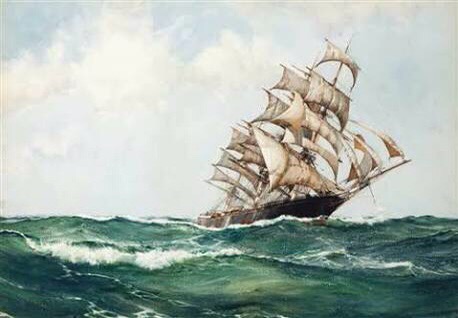
When the steamship was invented at around about the turn of the 19th Century, it was slow, costly and inefficient — certainly no match for sailing clipper ships. In the early years, most of a steamship’s cargo space was actually taken up by fuel-storage.
Slowly however, steam technology progressed. And after about a century, the economics of steam really started to challenge sail power.
In response to this challenge, Big Sail made improvements wherever they could. They added an extra mast to their ships, increased the waterline, strengthened the boats with steel, expanded the cargo space and made other improvements that would help make the ships sail even faster. In fact, in the 50 years after the introduction of the steam ship, sailing ships made more improvements than they had in the previous 300.
Of course, as the clippers improved, so did the steamships. The two technologies raced each other until finally sails reached their natural limit, and steam power won out.
The innovations that the clippers introduced were not anything radical. They didn’t require any new inventions, just incremental improvements. And for over a century, these incremental improvements drove productivity gains across the sector.
The basic lesson here is that while in the long run, incumbents will lose to new technologies, they don’t sit idly by in the meantime. Indeed the very threat of disruption/displacement/substitution by a new radical technologies can spur rapid improvements in an old and established technology.
Newspapers love to yell “shark!”. Except when it comes to digital disruption when they yell “jobs!” instead. These are actual headlines:
· Almost 40 per cent of Australian jobs could be replaced by technology by 2025
· Robots will steal 5 million jobs by 2020
· These 10 Professional Jobs Are Under Threat From Big Data
· 5 white-collar jobs robots already have taken
The “sailing ship effect” however, highlights the endogeneity that’s built into the economy. Markets respond to threats and opportunities in all kinds of interesting ways. Firms go on the defensive. They go on the offensive.
Workers diversify and build their skill-base. Entrepreneurs emerge out of nowhere. And perhaps most importantly, prices adjust.
We see the sailing ship effect playing out in a number of technology races today. Electronic vehicles have spurred the development of hybrids. Challenges from gas and renewables have brought on the development of supercritical, ultra-supercritical and advanced ultra-supercritical coal fired power plants.
The inherent responsiveness of the economy means that very rarely do we see cliff faces. It may happen from time to time (eg. Uber), but this is likely due to often other inefficiencies. Very rarely does a new technology appear that a) we didn’t see coming, and b) is able to uproot incumbents overnight — especially when the stakes are high.
 TALES FROM THE LONG TAIL
Leave a comment